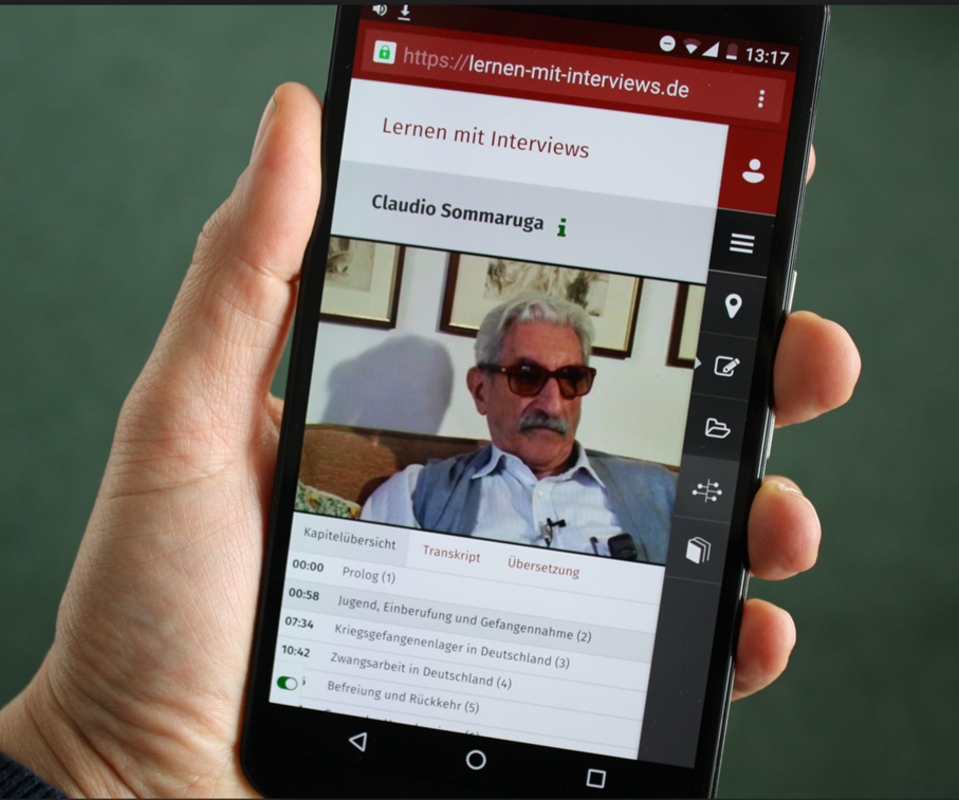
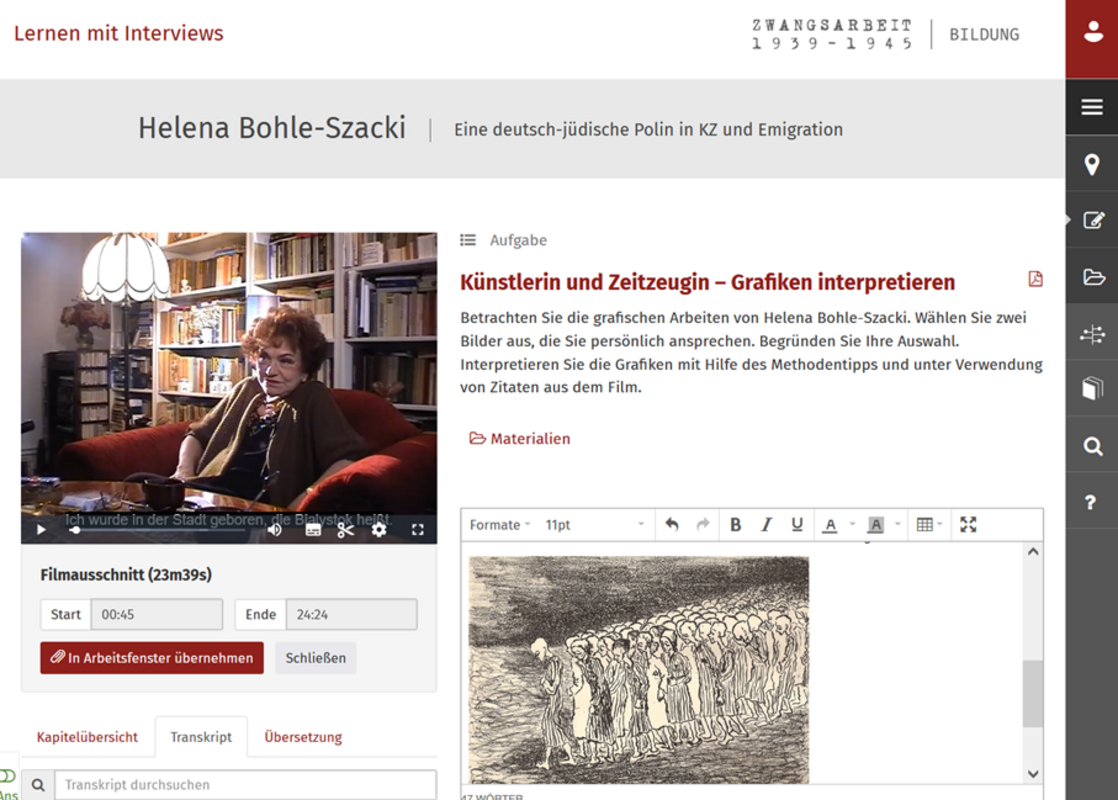
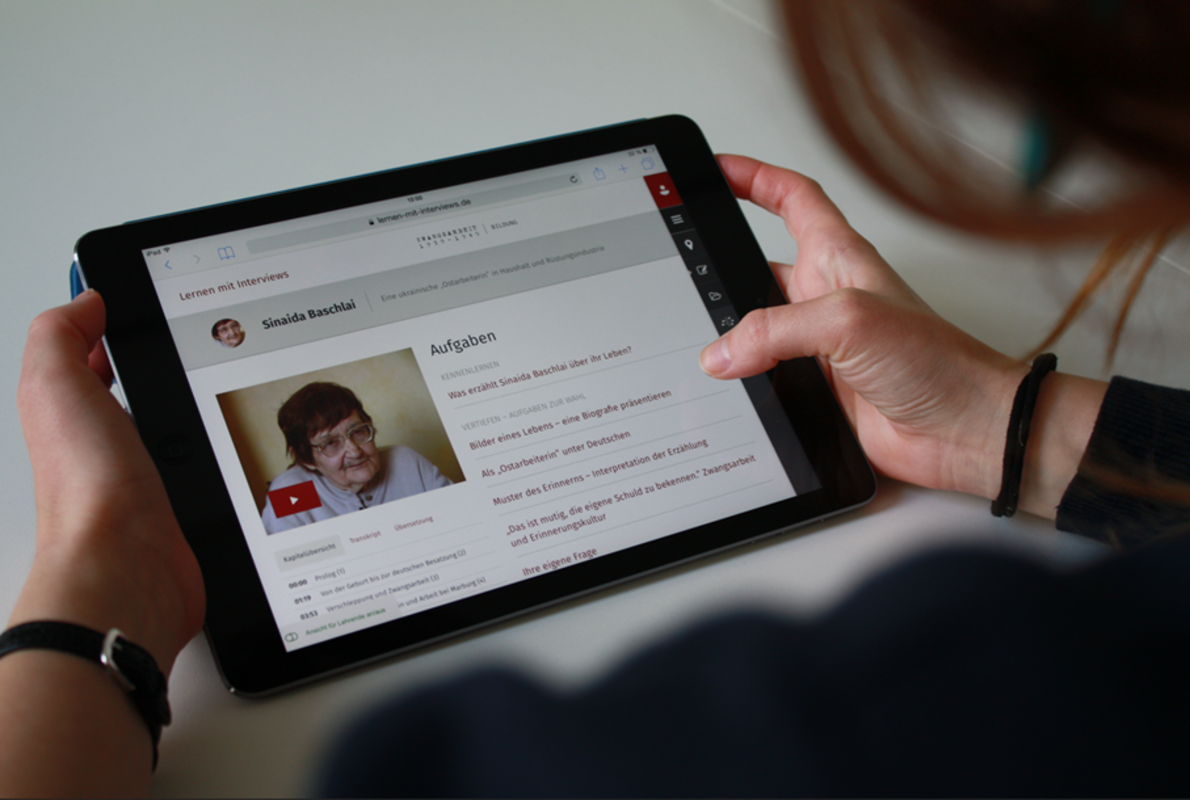
The online application ‘Learning with Interviews: Forced Labor 1939-1945’ is an educational resource for young people aged 14 and older. It promotes narrative skills and encourages active remembrance of Nazi forced labor and its aftermath.
It focuses is on the life stories of former forced laborers. In short films, seven survivors from different groups talk about their experiences in camps and factories, the behavior of the Germans, and their lives after the end of the war. It includes testimonies in English, German, Italian, Polish, Russian, Czech, and French.
The 25-minute biographical short films are based on video interviews from the online archive ‘Forced Labor 1939-1945.’ Two background films are included: one provides information about forced labor and compensation; the other provides context about oral history as a method and primary source Suggested tasks, informational texts and tips on methods, a timeline, a glossary, documents and interactive maps help users to understand and contextualize the testimonies.
The tasks are suitable for different levels and can be completed directly in the learning environment's editor. Work results can be compiled, presented or printed using the ‘My Results’ portfolio function. These materials and functions enable inquiry-based learning in standard lessons, digital/hybrid formats, and during project days.
Didactic comments and the memo function support group-specific lesson preparation. Teachers can also add their own tasks as needed. The application can be used collectively via a projector, in pairs in the computer room, or individually on a laptop, tablet or smartphone. Using personalized accounts, students can complete and prepare or watch short films work beyond class time.
Separate country versions of the online application have also been developed for The Czech Republic, Russia, and Poland: The Prague based organization ‘Živá paměť’ has prepared the Czech learning environment ‘Nucená práce 1939-1945’. The Russian learning platform ‘Обучение на основе интервью’ was created by the Regional Centre for Oral History in Voronezh. The Polish learning environment ‘wojna i pamięc’, was created by the KARTA Foundation in Warsaw.
Contents
Seven 25-minute video interviews
Background films on Nazi forced labour and oral history
Tasks with workspaces and materials
Save, print and present results
Photos, documents, maps, timeline, glossary and tips on methods
People and groups
Sinaida Baschlai: A Ukrainian ‘Ostarbeiterin’ in domestic service and the arms industry
Reinhard Florian: Persecution and slave labor of a German Sinto
Helena Bohle-Szacki: A German-Jewish Polish woman in concentration camps and emigration
Claudio Sommaruga: Forced labor and defiance by an Italian military internee
Anita Lasker-Wallfisch: Musician – Jew – Survivor
Victor Laville: A French forced laborer in Bavaria
Marie Jeníková: A Czech woman in the BMW armaments factory
Target groups
For standard lessons, projects, research papers, and presentation-based exams
Competence-oriented and interdisciplinary: History, English, Art, etc.
For bilingual lessons and multilingual learning groups
LINK to the application: lernen-mit-interviews.de/
CONTACT:
mail@zwangsarbeit-archiv.de